
Pending vs Paid Balance: Where Miners Get Confused
Pending balance is work the pool has already accepted but has not yet settled; paid balance is coin that has been credited to an account you control. On the default PPS+ method those are different numbers because settlement runs hourly against current difficulty: a 1 PH/s machine produces about 0.0000187 BTC — roughly $1.58 at a BTC price of $84,692 — in each hour of valid shares. So a dashboard showing a large pending figure next to a smaller paid figure is usually working correctly, not shorting you.

Key takeaways
- Pending is an estimate of accepted shares that have not settled; paid is a completed credit. With PPS+ the gap should close on an hourly rhythm, not weekly.
- The two components of a payout carry different listed fees — 4% on the PPS-settled block-reward part and 2% on the fee-distributed part — so pending can shift even when your hashrate is flat.[1]
- Under PPLNS, nothing is owed to you until a block the pool found has 6 confirmations, and the split uses your share of pool hashrate over the last 5 difficulty rounds.
- Reconcile monthly against one benchmark: at 100 TH/s the pool share is about $3.80 per day gross, or roughly $3.65 after the listed 4% block-reward fee.
Why the numbers move when nothing broke
Mining payouts are a chain of estimates. Your miner submits shares; the pool validates them and prices them; the settlement engine converts that value into a balance; the payout rail moves coin from pending to paid. At every hop the number can change without a single machine going down.
Difficulty is the first reason. It is retargeted roughly every two weeks, and the estimate for the next adjustment on 21 September 2026 was -2.12%. That estimate is visible before the adjustment lands, so a miner watching a difficulty-aware dashboard will see pending value drift in anticipation of a retarget that has not happened yet. Nothing is wrong with the hardware — the denominator moved.
The second reason is the fee structure itself. ViaBTC publishes two payment methods, PPS+ as the default and PPLNS as the alternative, and the listed rates apply to different components of a payout rather than to one lump sum.[2] Because the transaction-fee component is distributed with PPLNS logic, its value depends on how busy the chain is on the day a block is found. A quiet mempool means a thinner fee slice, and a thinner fee slice means pending looks soft even though the block-reward part was paid exactly as agreed.
What changes your payout
Four inputs decide the gap between what a dashboard shows and what a wallet receives. Hashrate is the obvious one. Uptime is the one miners underestimate: an offline hour is not a delayed payout, it is a permanently missing one. Pool share of network hashrate sets the ceiling — you cannot earn more than your slice of the 450 BTC mined network-wide each day, which is about $38.1 million at today's price. And the payment method decides when and how reliably that slice arrives.
| What you see in the dashboard | PPS+ (default) | PPLNS |
|---|---|---|
| Block-reward component | Settled per accepted share at current difficulty, listed fee 4% | Distributed after the pool finds a block, listed fee 2% |
| Transaction-fee component | Distributed with PPLNS logic, listed fee 2% | Merged with the block reward, listed fee 2% |
| When pending becomes paid | Every hour | After 6 confirmations on the pool's block |
| Who absorbs pool luck | The pool | The miner |
| Window used for the split | Not applicable, paid per share | Miner's share of pool hashrate over the last 5 difficulty rounds |
Read that table as a set of different clocks rather than different prices. Both methods aim at the same expected value per unit of hashrate; they differ in how much variance the miner carries and how long coin sits in pending. A miner on PPS+ who checks the dashboard at 10:20 may see an hour of unsettled work that a PPLNS miner would not see at all, because the PPLNS balance only materialises around blocks.
Worked example: a 10 PH/s farm over one month
Take a 10 PH/s operation running at 20 J/TH. Against a network hashrate of about 1,003 EH/s, that is a share of 9.97 × 10⁻⁶. Network-wide, 144 blocks per day pay out 450 BTC, so the farm's gross share is roughly 0.004486 BTC per day. At $84,692 per BTC that is $379.93 per day gross, and $364.74 per day after the listed 4% on the block-reward component — an hourly credit near 0.00018692 BTC, about $15.83.
The same machines draw about 200 kW, which is 4,800 kWh per day and roughly $288 of electricity at $0.06/kWh. Gross income minus power leaves about $76.74 per day on that single-site setup before hosting, cooling and repairs. Now look at what a one-day settlement delay does: an entire day of production sits in pending, which at this scale is $364.74 of working capital parked in the pool's ledger rather than available for the power bill.
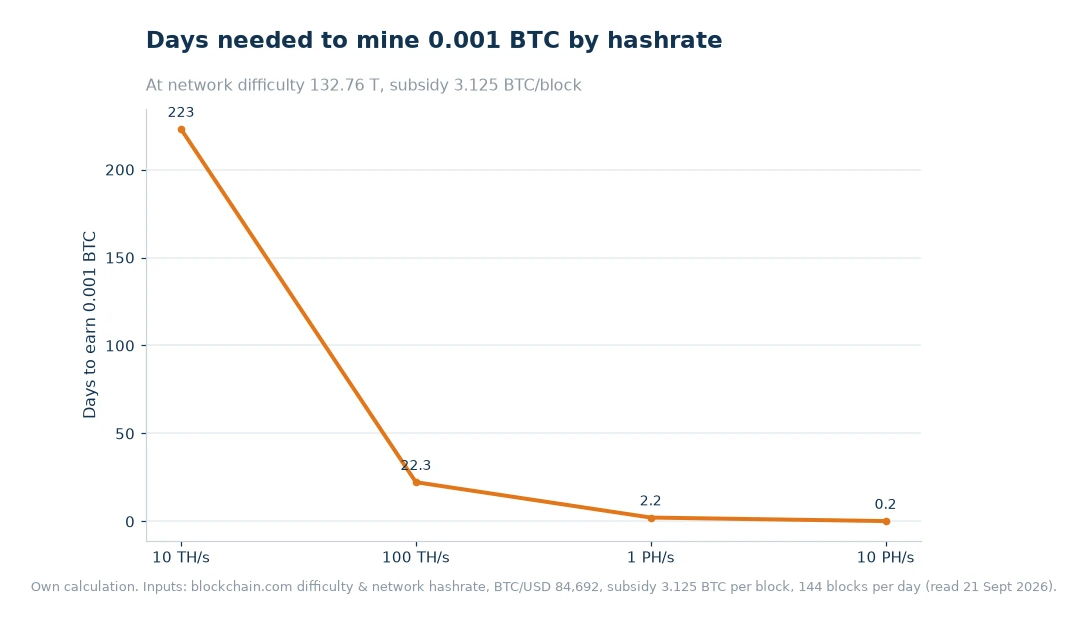
That is the real value of hourly settlement: it is not a marketing number, it is the size of the float you do not have to fund from somewhere else. The same effect works in reverse for a small miner. A single 100 TH/s machine earns about $3.80 gross per day, so a monthly settlement cycle would leave roughly $114 of production in pending at any moment — more than most people keep as a spare parts budget.
What to check once a month
- Sum your paid credits, not your pending snapshots. One dashboard screenshot proves nothing; a month of credits divided by a month of uptime is a number you can defend.
- Compare effective rate with an estimate. Run your hashrate and the current difficulty through the income calculator and check the modelled daily output against what actually landed. A persistent gap points at uptime, not fees.
- Watch the pool's share of network hashrate. Track your own hashrate against the pool's published mining statistics; a pool that is losing share can change how lumpy PPLNS distributions feel.
- Check the difficulty estimate before you blame the pool. A -2.12% estimate two weeks before a retarget changes pending value in both directions.
- Confirm where the coin lands. Zero-fee mining payouts and an in-account wallet mean the pending-to-paid leg is the only hop that matters, because the withdrawal leg adds no cost of its own.
- Keep a per-worker view. One dead machine among forty is a 2.5% revenue cut that a farm-level average will hide for weeks.
If you want the outside view, the public pool-state page publishes ViaBTC Pool Hashrate next to network hashrate and difficulty, which lets you compute your own slice of the pool without waiting for a statement. Compare that ratio month over month; if it falls while your machine count is unchanged, the network grew and your pending estimate was always going to shrink with it.
Frequently asked questions
Can I mine more than one coin at the same time?
Yes. Merged mining lets a machine secure a parent chain and an auxiliary chain together, and multi-coin pools support switching between chains without moving hardware. That matters for balance accounting because each chain keeps its own difficulty, block cadence and settlement timing, so pending balances on two farms are rarely comparable at a glance.
Do mining pools cost anything to join?
Joining is free; the pool earns from its fee on settled payouts, which appears as a percentage of the block-reward and transaction-fee components. There is no membership charge and no listing fee, so the cost difference between two pools lives entirely in those two percentages and in how often you get paid.
Is a large pending balance a warning sign?
Only if it stops clearing. Under PPS+ the block-reward component settles hourly at current difficulty, so a pending figure that grows for days usually means a payout threshold, a verification step or a worker that is no longer submitting shares. Under PPLNS, a growing pending balance around a dry spell is normal until the pool finds its next block.
Reconcile one month, then stop guessing
Write down three numbers at the end of a month: BTC credited, hours your machines actually ran, and the difficulty you mined against. Divide credited BTC by uptime-hours to get BTC per hour, then compare that with the theoretical figure your total hashrate implies. If they match within a few percent, the pending-versus-paid gap is accounting, not loss, and you can stop refreshing the dashboard.
Data and sources: ViaBTC fee schedule and payout methods[1][2], ViaBTC earnings calculator[3]. Network difficulty 132.76 T, network hashrate, 3.125 BTC block subsidy, 144 blocks per day and a BTC price of $84,692 were read from public chain data and market feeds on 21 September 2026. All earnings figures are illustrative own calculations and change with difficulty, price and uptime.